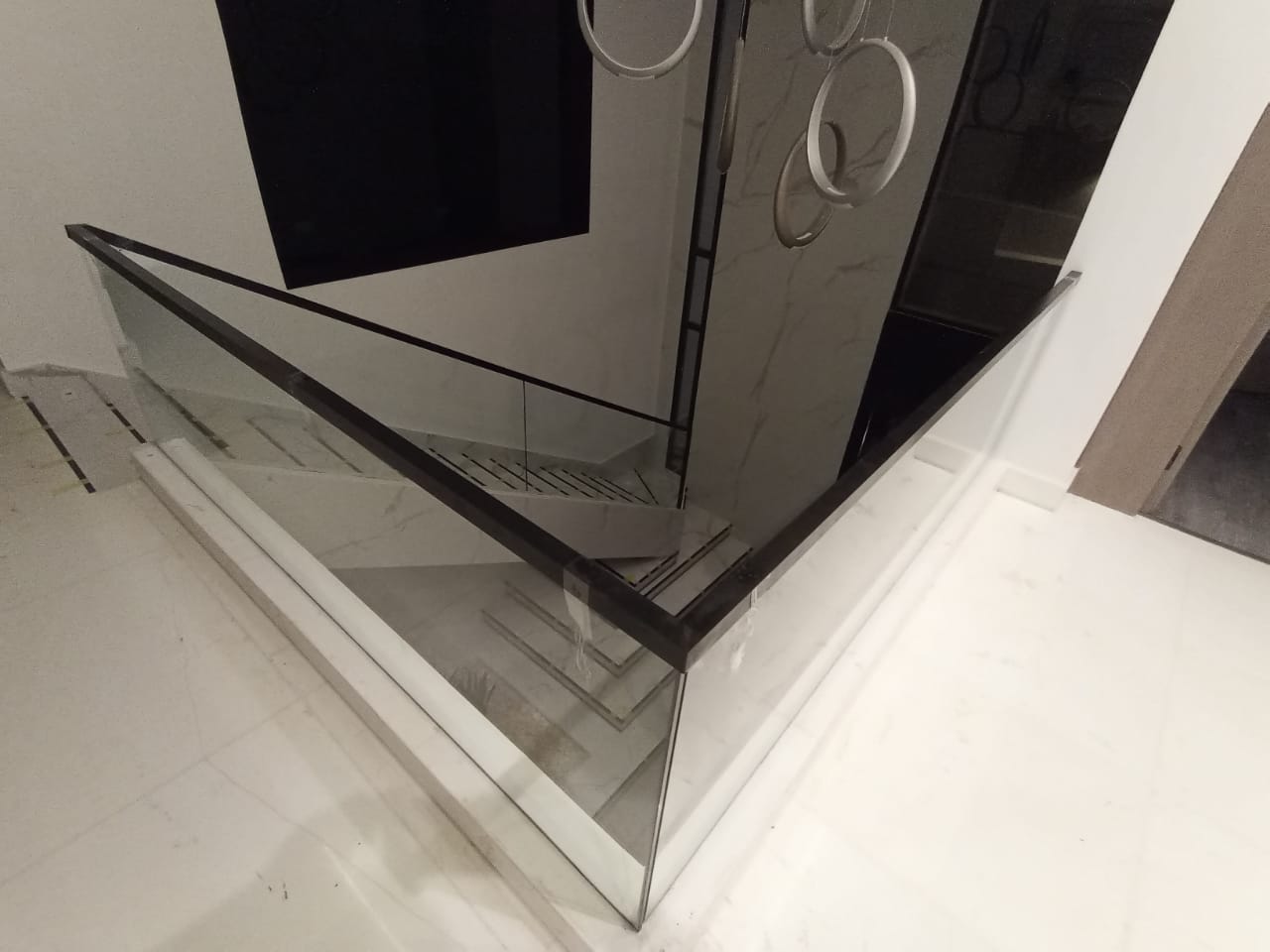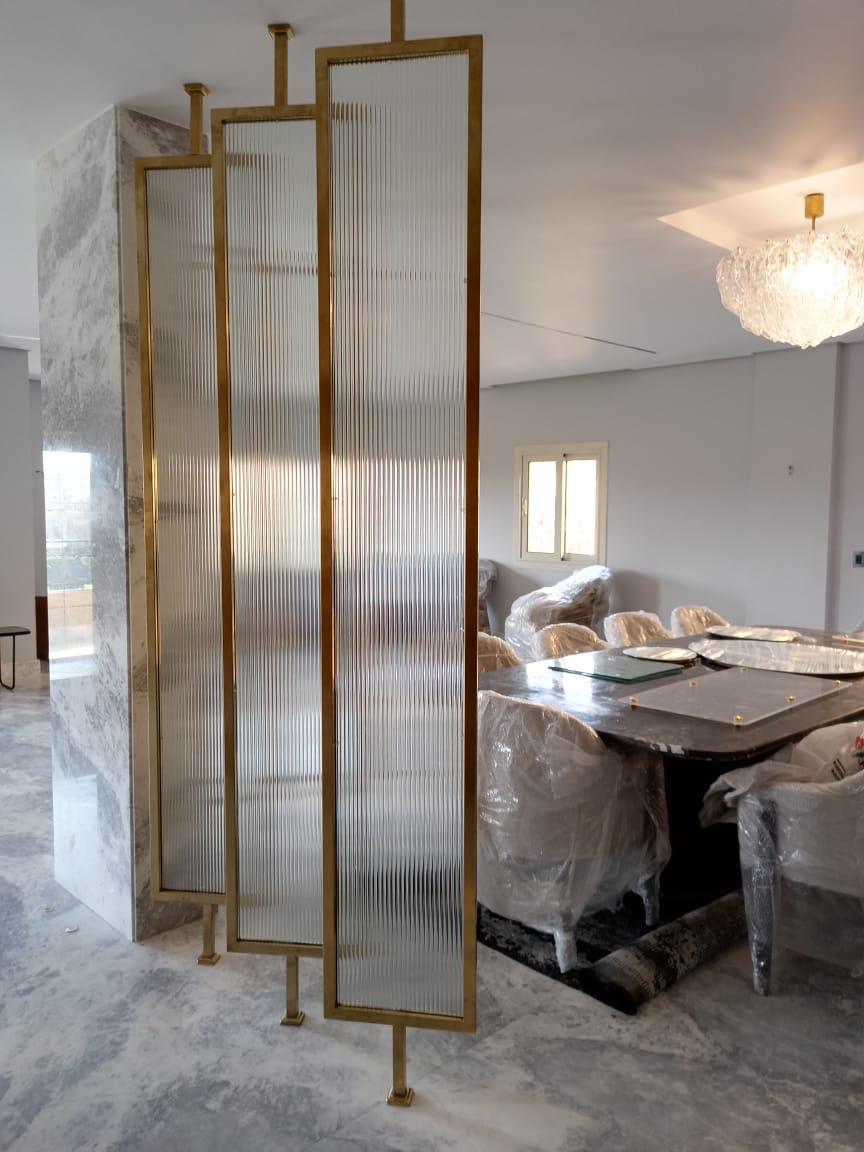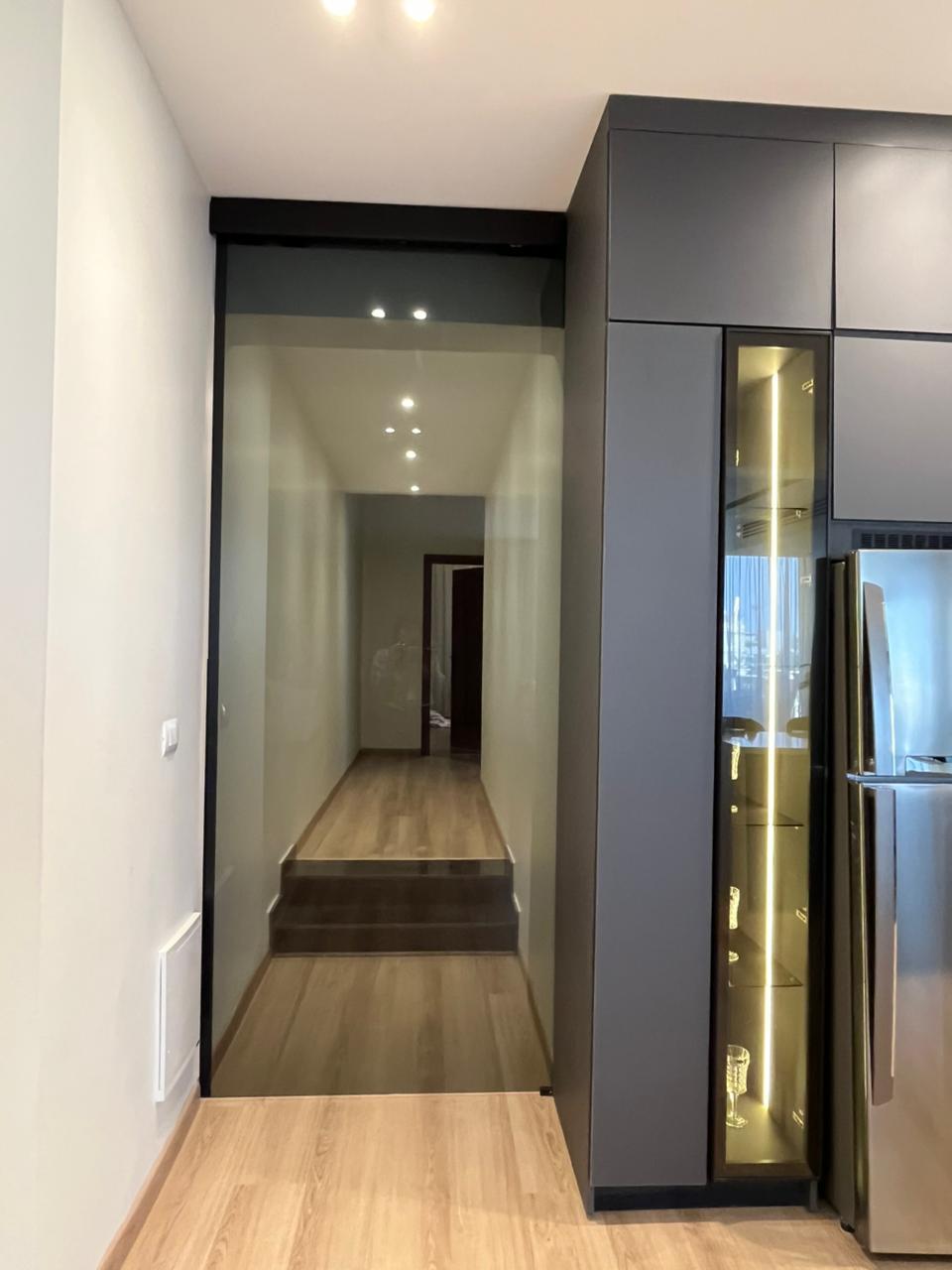
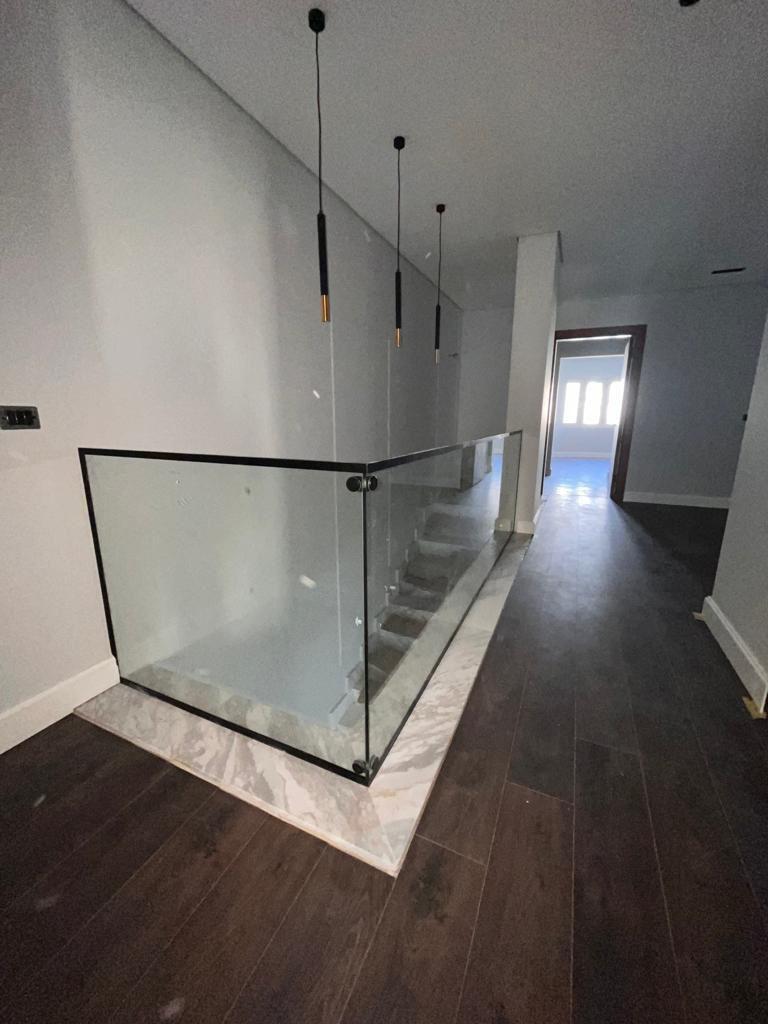
Short answer: choose tempered glass where you need strength and safe breakage in a framed or supported panel, such as shower cabins, glass doors, partitions and table tops. Choose laminated glass wherever a broken pane must stay in place: handrails and balustrades, skylights and overhead glass, shopfronts, and rooms that need sound insulation. For frameless balustrades, the best answer is often both: tempered glass laminated together.
What is tempered (toughened) glass?
Tempered (toughened) glass is ordinary float glass that is heated to around 600 °C and then cooled very quickly with air jets. This locks the outer surfaces in compression and the core in tension. The result is glass that is typically 4 to 5 times stronger than ordinary annealed glass of the same thickness, and much more resistant to sudden temperature changes.
When tempered glass does break, it shatters into small, blunt granules instead of long sharp shards. That is why it is called safety glass.
Two practical points every customer should know:
- It cannot be cut or drilled after tempering. All sizes, holes and notches for hinges and handles must be made before the glass goes into the furnace. Accurate site measurement is therefore essential.
- Once broken, it loses all strength. The whole pane collapses into granules, leaving the opening empty.
What is laminated glass?
Laminated glass is two or more sheets of glass bonded together with a plastic interlayer under heat and pressure. If the glass breaks, the fragments stay stuck to the interlayer, so the pane stays in its frame and is hard to push through. This is the same principle used in car windscreens.
The interlayer also brings extra benefits: it reduces noise and, with PVB or EVA interlayers, blocks most UV radiation that fades furniture and floors.
Tempered vs laminated: side-by-side comparison
| Property | Tempered glass | Laminated glass |
|---|---|---|
| Strength | Typically 4 to 5 times stronger than annealed glass | Depends on the glass used; can be made from tempered sheets for high strength |
| When it breaks | Small blunt granules; the opening becomes empty | Cracks but stays in place on the interlayer |
| Security | Breaks completely once shattered | Difficult to penetrate |
| Sound insulation | Similar to normal glass | Better, especially with acoustic PVB |
| UV protection | Limited | Blocks most UV with PVB or EVA |
| Can be cut after production | No | Annealed laminated: yes. Tempered laminated: no |
| Typical uses | Shower cabins, glass doors, partitions, table tops | Handrails, balustrades, skylights, shopfronts, soundproofing |
Which one should you choose for each application?
Glass handrails and balustrades
Choose laminated glass, ideally made of two tempered sheets. If one sheet breaks, the balustrade still stands between people and the drop. A single tempered pane may be strong, but if it breaks it leaves the edge completely open. Typical balustrade glass ranges from 12 mm to 21.52 mm depending on height, fixing and loads.
Shower cabins
Tempered glass, usually 8 to 10 mm for doors and up to 12 mm for fixed panels, is the standard choice. It is strong, safe when broken, and handles hot water and steam well.
Skylights, canopies and any glass overhead
Always laminated. If overhead glass breaks, the pieces must not fall on people below.
Shopfronts and ground-floor windows
Laminated glass adds security against break-ins, and keeps the shop closed even if the glass is cracked.
Office partitions and meeting rooms
Tempered glass (10 to 12 mm) suits most partitions. Choose laminated acoustic glass for meeting rooms where privacy of conversation matters.
PVB, EVA or SGP: which laminated interlayer?
Not all laminated glass is the same. The interlayer decides how it performs:
- PVB (polyvinyl butyral) is the global standard: clear, good sound insulation, strong UV filtering. It is used in the large majority of laminated glass worldwide.
- EVA (ethylene vinyl acetate) resists moisture better at exposed edges and can hold decorative fabric or mesh inside the glass. It suits bathrooms and decorative interior glass.
- SGP (ionoplast) is far stronger and stiffer than PVB and keeps a residual barrier even after both glass layers break. It is the premium choice for frameless balustrades, glass floors and canopies.
Tempered and laminated glass in Egypt’s climate: heat, sun and the coast
Strong sun, big temperature swings and salty coastal air all affect glass and its hardware.
- Heat and thermal stress: large sunny panes heat unevenly. Tempered glass resists this thermal stress far better than ordinary glass.
- Spontaneous breakage: very rarely, a tiny nickel sulfide inclusion inside tempered glass can make a pane break on its own, sometimes years later, often in hot weather. For large facade or overhead panes, a heat soak test (re-heating the tempered glass in a chamber so that affected panes break in the factory instead of on site) greatly reduces this risk. Laminated glass keeps the pane in place even if it happens.
- Coastal projects: on the North Coast, Ain Sokhna and Red Sea, choose marine-grade SS 316 fittings for handrails and doors to resist salt corrosion.
How to check what you are getting: ask your installer to state the glass type, thickness and interlayer in writing, for example “tempered laminated 6 + 6 mm with 1.52 mm PVB” (about 13.5 mm in total). Tempered panes usually carry a small permanent mark in one corner. A trustworthy supplier will explain the specification and why it suits your opening.
Frequently asked questions
Is tempered glass the same as safety glass?
Tempered glass is one type of safety glass, because it breaks into small blunt granules. Laminated glass is the other main type, because it holds together when broken. For some uses, such as balustrades, laminated tempered glass gives the best of both.
Can laminated glass be tempered?
Yes. Each glass sheet is tempered first, then the sheets are laminated together with the interlayer. This combines high strength with post-breakage safety.
Why did my tempered glass break by itself?
The most common cause of a tempered pane breaking without impact is a tiny nickel sulfide inclusion, or damage to the glass edge during installation. Heat soak testing reduces the inclusion risk for critical panes.
Can I cut tempered glass to size on site?
No. Tempered glass shatters if you try to cut or drill it. Every size and hole is made before tempering, which is why M-Square measures on site before fabrication.
Which glass is best for a staircase handrail?
Laminated glass, usually made of two tempered sheets, so the guard stays in place even if one sheet breaks. The exact thickness depends on the height, the fixing system and the loads.
Is toughened glass the same as tempered glass?
Yes. Toughened glass, tempered glass and “securit” (سيكوريت), as it is called in Egypt, are the same heat-treated safety glass that breaks into small blunt granules.
Sources and further reading: Vetrotech: laminated vs tempered glass · Bendheim: what is heat-soak testing? · Techniques de l’Ingénieur: interlayers for laminated glass
Need advice for your project?
Our technical office replies with honest recommendations and an itemised quotation, or visits to measure on site.